Case · Ride-Next
A trip log that keeps itself.
Ride-Next is our fourth product of our own and our second native Android app: a trip log for people who drive for work, in a company car, a van or their own car. In five languages, on phone, foldable and tablet, and now in closed testing for Google Play.
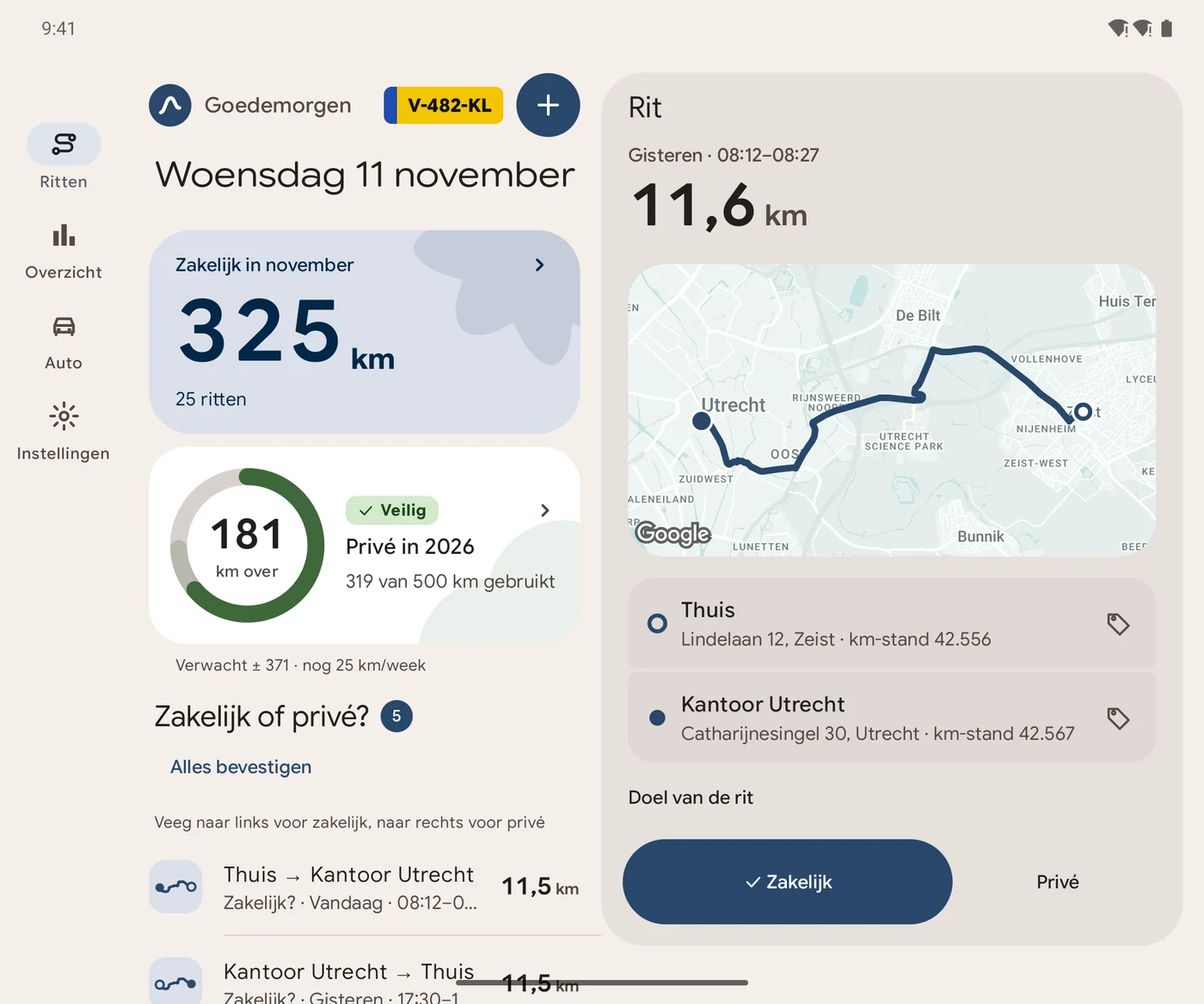
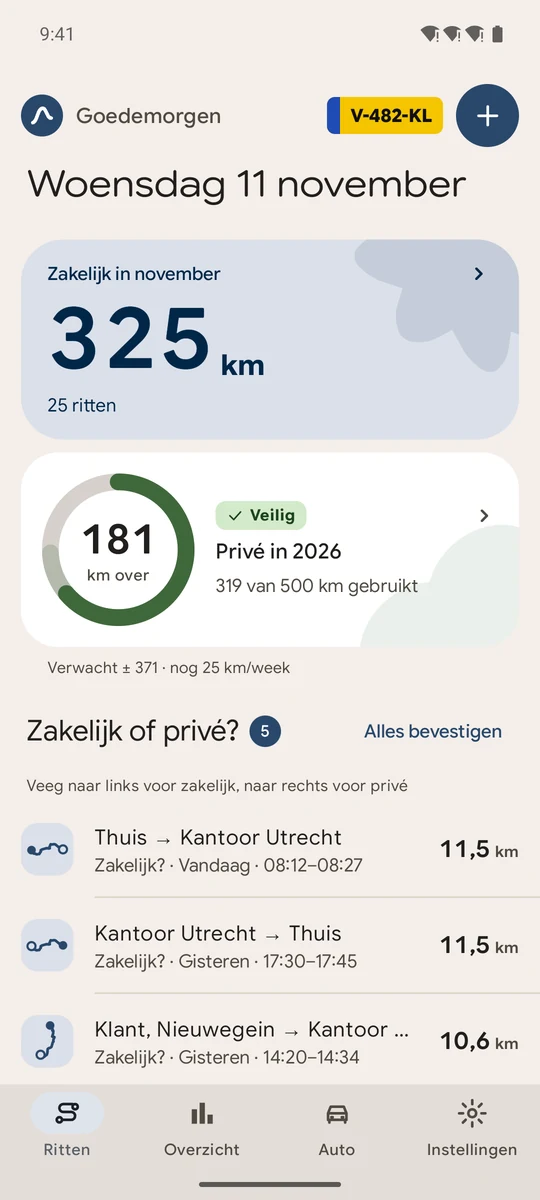
- 3 screen sizes
- 5 languages
- 0 servers of ours
- Beta closed test, Google Play
The problem
In the Netherlands, a company-car driver who wants to avoid the taxable private-use addition has to show they drove no more than 500 km privately in a year. The proof is a complete trip log: every trip with odometer readings, addresses, business or private, and its purpose.
A log you have to keep yourself does not get kept. One forgotten trip is a hole in the proof, and a trip you made as a passenger does not belong in it.
What was built
A trip starts by itself as soon as the phone connects to the Bluetooth of your own car, and only that car. Every trip proposes itself as business or private, based on working hours and named places such as Home or Office; confirming is a single swipe, left for business and right for private.
The 500 km private limit sits as a ring on the first screen, with a forecast to 31 December and four fixed states: safe, watch, risk and over the limit. You read your odometer with the camera; the difference with the measured trips becomes a correction trip. Trips can be split, joined and added afterwards, and every change is recorded. A yearly and monthly report comes as a PDF, and all trips can always be exported as CSV.
How
Kotlin and Jetpack Compose with Material 3 Expressive, on a design system of its own: few colours, warm neutrals and big quiet numbers, like the dashboard of a good car. Business and private differ in hue and in lightness, so a colour-blind driver can tell them apart too. On a foldable or tablet the list and the trip sit side by side.
Everything stays on the phone, with a backup in the user's own Google account. There is no account with us, no analytics and no advertising. Store texts, screenshots and releases go to Google Play through its API, and a script makes the screenshots on the emulator: a new version is a single command.
Ride-Next records trips; the tax assessment stays with the user and the Dutch tax authority.
What it demonstrates
That the way Hangar-Next was built is repeatable. An app is only done with everything around it: privacy policy, terms of use, store listing, five languages and screenshots that follow every version by themselves.
And that a small app is a product when it does exactly what the rules ask, and promises nothing beyond that.
Stack
- Kotlin
- Jetpack Compose
- Material 3 Expressive
- Google Maps
- ML Kit text recognition
- Glance widget
- WorkManager
- Google Play Billing
Let's talk
What are we building?
One conversation is enough to know whether we fit. Tell us what you have in mind — we will tell you how fast it can happen, and whether we are the right people for it.